Showing posts with label reviews. Show all posts
Monday, March 23, 2015
'71
'71
Dir. Yenn Demange
3.5 out of 5
In the opening scenes of '71, Gary Hook (Jack O'Connell) is part of a regiment of young British soldiers training for their eventual deployment overseas. But the action they see will not be far from home - just across the Irish Sea, in fact - as the soldiers are ordered to ameliorate the internecine conflict between Catholic and Protestant militias in Belfast, Northern Ireland, in the early years of what would quickly become known as the Troubles. During his squad's first mission in the field, Gary becomes separated from his unit and embarks upon a dangerous journey through Belfast that exposes him to the ethical complexities and diverse combatants in this tangled sectarian conflict.
While Yenn Demange's film has an academic interest its many different factions vying for power in Northern Ireland - staunch Protestant loyalists, shady British military intelligence agents, and two squabbling groups of fiery IRA nationalists - it's ultimately about the corrupting nature of war in general. Seen through Gary's relatively innocent eyes, the brutal violence is an almost apolitical byproduct of base human impulses that go beyond the immediate 20th-century concerns of government and religion. Demange and screenwriter Gregory Burke aren't creating a historical document here - they are crafting a passion play within the structure of an urban action thriller, replete with stunning escapes, double-crosses, and unlikely allies.
Indeed, labeling '71 as simply a "war movie" belies its focused intensity and would muddle the broader message its creators are attempting to convey. Its ideals are not glory or honor but a certain humanity - albeit a tragic one - that persists in some of the most hopeless situations. On the other hand, the film's scale sometimes tips too far into the symbolic; the deeper Gary falls into his predicament, the more he functions as a plot point than as a character. Demange also seems to squander '71's specificity in the characterizations of the supporting cast, whose motives either remain unclear or are spelled out in a somewhat clichéd language. Still, '71 is absolutely captivating whenever lives hang in the balance and Gary is on the run - which is to say almost the entire time. The filmmakers' general political ambivalence turns out to be a wise choice for the type of movie that '71 so frequently is: a tense, protracted chase sequence through a maze of crooks, charlatans, and collaborators.
Tuesday, March 17, 2015
Chappie
Chappie
Dir. Neill Blomkamp
2.5 out of 5
It takes a village to raise an automaton. That's the most cogent takeaway from the sci-fi thriller Chappie, in which the architect (Dev Patel) of Johannesburg, South Africa's robotic police force uses a decommissioned machine to produce a sentient form of artificial intelligence. But when the little guy, childlike and helpless, falls into the hands of some desperate street thugs, his development oscillates between the warm, compassionate wonderment supplied by his surrogate mother (who impulsively dubs him "Chappie") and his criminal exploitation at the hands of his father figure - played respectively by South African rappers Yolandi Visser and Ninja, better known as Die Antwoord. Then there is the harsh, violent reality of Chappie's environment, where a stable urban society exists adjacent to a quasi-Mad Max wasteland, characteristic of director Neill Blomkamp's consistent predictions of a future starkly divided between the haves and have-nots.
Chappie, at its core, is not so different from Boyhood - if Boyhood also featured a beefed-up version of the ED-209 from RoboCop controlled by the thoughts of an ex-military hardass (Hugh Jackman). The film's coming-of-age element maintains a critical emotional through-line within Blomkamp's loud, hyper-stimulated action aesthetic. The tenderness and cute humor of Chappie himself - animated via the vocal and "poor man's motion capture" performance of Sharlto Copley - cuts through the static of an energetic but often hopelessly cluttered script. Co-writers and real-life partners Blomkamp and Terri Tatchell have crammed enough ideas and subplots for multiple movies into Chappie, resulting in a film that feels disjointed for its first two-thirds, then hopelessly rushed once it's time to tie all the threads together.
But some of those threads, taken individually, can be quite intriguing. Much like Ninja is obsessed with teaching Chappie all about the hard knocks of life in the slums - and the exaggerated macho hardness that's required to endure them - Blomkamp is preoccupied with the idea of authenticity expressed as coolness. He's mashing up the worlds of Coachella and SXSW, alternating between the profanely-tagged abandoned rave site that is the criminals' hideout and the sleek, supermodern technocracy where Patel's and Jackman's characters are rivals jockeying for position in the pecking order of scientific and cultural innovation. In the end, Chappie's own cinematic parentage is an amalgamation of Blomkamp's two previous films, Elysium and District 9; it's both a hopelessly confusing crackpot mess and a visually stunning work of ambitious social import.
Saturday, March 14, 2015
It Follows
It Follows
Dir. David Robert Mitchell
3 out of 5
Dir. David Robert Mitchell
3 out of 5
We all know what happens to
the sexually promiscuous (or even just the sexually active) in horror films: once
the clothes come off, a grisly death usually isn't far behind. The teen
chiller It Follows, from
writer-director David Robert Mitchell, magnifies this trope to movie size:
after teenage Jay (The Guest’s Maika
Monroe) sleeps with the older boy (Jake Weary) she's been dating, she's
haunted by spectral visions taking the form of various people, often
creepy-looking and disturbingly mutilated strangers. Jay's lover has the
courtesy to explain, post-coitus, that it's a condition passed down a long line
of sex partners and that his only motive in courting her was to rid himself of
the curse, as the visions will relentlessly hunt down and kill the most recent
link in the chain.
It wouldn't take much to
push this premise into exploitation territory, but Mitchell takes it in a more
introspective direction, trying to examine the impact Jay's situation has on
her relationship with her friends: younger sister Kelly (Lili Sepe), schoolmate
Yara (Olivia Luccardi), bad-boy neighbor Greg (Daniel Zovatto), and childhood
crush Paul (Keir Gilchrist). Only the afflicted can see the visions, so
they spend much of their time consoling Jay without knowing exactly why.
Jay herself is a fascinating character, contemplating the morality of her
limited options in relieving herself of the curse. Together, they all
perform the duties of friendship in a sensitive interplay that would feel very
realistic for a conventional coming-of-age drama, much less a horror film.
The premise lends itself to
a metaphor for teen sex, one that Mitchell complicates with the ever-changing
form of Jay's tormentors and the detail that they will only pursue their
victims slowly, on foot. They're never a powerfully overwhelming force
but a consistent creeping dread in the back of Jay's mind. What she is
interpreting, Mitchell cannot truly say. His script mines a motherlode of
mental triggers, from post-pubescent confusion and anxiety about sex to a
recalling of the emotional scars left by our earliest intimate relationships,
even suggesting a component based on the repression of sexual trauma.
The last thing this movie
needs is a moral, but it seems to be grasping at a larger purpose that is not
made fully clear. Granted, that's Mitchell's likely intention, but his
lyrical approach short-sells the potential of the conceit. He delights in
constructing a formal mystery house of atmospheric slow zooms, pans that lead
to nowhere, and nerve-fraying sound design. It's top-notch horror movie
affect. It's also pretty frustrating without the right amount of payoff.
It Follows becomes a slow-speed chase film for almost
its entire second half, a repetitive exercise no matter how many times the nightmare
changes its disguise. Mitchell's gift for wan understatement also doesn't
mesh well with a young cast struggling to communicate the film's intensely
psychological conflict. It Follows is ultimately a great
idea resting upon a wobbly framework, trying mightily to strike its own
balance between the codification and deconstruction of horror tropes.
This review was originally posted to Screen Invasion.
Saturday, February 21, 2015
Kingsman: The Secret Service
Dir. Matthew Vaughn
4 out of 5
The titular organization in Kingsman: The Secret Service is an international spy agency that's not MI-6, even though everyone involved just happens to be British. Nor are its gentlemen agents who wear fine suits, deploy lethal gadgets, and infiltrate underground lairs supposed to be any kind of stand-in for a certain type of spy who emerged in the golden age of cloak-and-dagger during the Cold War. (Their origin has something to do with tailors and the fortunes of wealthy casualties in World War I.) Indeed, Kingsman borrows as many of its cues from modern fairy tales like Star Wars and Harry Potter as it does from spy movies. Consider its protagonist: Gary "Eggsy" Unwin (Taron Egerton), a poor London youth whisked away from his troubled home life to audition for an espionage program that tests the limits of his physical and psychological capabilities; whilst his mentor, top agent Harry Hart (Colin Firth), investigates a flamboyant tech billionaire (Samuel L. Jackson) for a litany of suspicious behavior, including but not limited to employing a personal assistant (Sofia Boutella) who sports razor-sharp foot prosthetics.
That last flourish is typical of Kingsman, a stylish spy thriller and love letter to the James Bond film series that does what many of the Bond films themselves cannot: land on the right side of the homage-parody divide. Of course, this is the old-school '60s and '70s Bond we're talking about, the movies stuffed with outlandish megalomaniacs, gimmicky henchman, and grounded gadgetry. But Kingsman is most intriguing in its attempt to best Bond in the personality department. From their tony headquarters on Savile Row to their emphasis on expertise and teamwork, these guys (and gals) take their self-appointed status as gentlemen quite seriously. It's a not-so-secret jab at the idea of a violent, vengeful Bond serving as a symbol of masculine cool; the Kingsman way is practically the opposite, according to Hart, who quotes Hemingway to his young protege: "True nobility is being superior to your former self."
It's another way of saying that you must be comfortable in your own skin, as director Matthew Vaughn certainly is. With Kingsman he finally combines his visual panache and cheeky sense of humor with thematic heft, as the film's the out-of-nowhere commentary on wealth, class, and privilege is a vast improvement over solipsistic missteps like Kick-Ass. This being Vaughn, the film is none too subtle, and several of its winks to other spy films are rather clunky. Yet it succeeds all the same by taking a different tack than lesser Bond imitators, which so often try to declare their importance by either symbolically murdering or pantsing Bond in a fit of desperation. Kingsman is the anti-anti-Bond film, working on multiple levels for many audiences: those who will recognize its tango with the history of the spy genre, those who appreciate a subversive product slipping through the Hollywood system, and those who simply want to sit back and enjoy the buoyant confidence of a movie that knows exactly how to find its own groove.
Wednesday, February 18, 2015
Seventh Son
Seventh Son
Dir. Sergei Bodrov
2 out of 5
Meryl Streep famously spoke of the difficulties that actresses face upon reaching a certain age - upon turning 40, she reportedly began receiving a deluge of offers to play witches, a role she resisted until last year's Into the Woods. The starkly generic fantasy Seventh Son seems a lot like the type of movie that Streep was turning down years ago. It's a film that has no use for female characters who aren't witches, or at least closely associated with the villainous coven led by Mother Malkin (Julianne Moore), a powerful sorceress who has returned after a decades-long exile to seek vengeance on John Gregory (Jeff Bridges), the "spook" - a kind of supernatural bounty hunter - who imprisoned her.
It's easy to read Seventh Son as a feature-length act of acquiescence. The movie squanders a talented cast on a pro forma hero's journey invested exclusively in meat-and-potatoes fantasy clichés (gee, I hope this magic pendant comes in handy later). As the last representative of an order dedicated to protecting people from evil magical creatures, Gregory is forever in search of a worthy apprentice. When his latest one dies, he tracks down Tom Ward (Ben Barnes), a restless farmboy so blatantly Skywalker-esque he actually stares into the middle distance and verbally confirms that he's meant for something greater than this. As they fight their way through Malkin's minions, Gregory gradually convinces Tom that bitches be crazy and that all witches should be summarily executed. However, the boy nurtures a seed of dissent when he discovers that a mysterious young woman (Alicia Vikander) accused of being a witch might not be so bad after all.
Monday, February 9, 2015
Jupiter Ascending
Jupiter Ascending
Dir. Lana and Andy Wachowski
2.5 out of 5
The Wachowski siblings' quest to out-weird themselves continues with Jupiter Ascending, a sprawling space opera that proudly chooses quantity over quality when it comes to the ideas that shape its original sci-fi narrative. And for a while, "quantity" doesn't seem like a bad choice: the film's whirlwind first act includes attempted alien abduction, cybernetically-enhanced bounty hunters, a caste of test-tube humans spliced with animal DNA, and the machinations of intergalactic aristocrats trying to gain control the most lucrative and resource-rich planet left to them in their late mother's will: Earth.
Caught in the middle of this madness is Jupiter Jones (Mila Kunis), a humble domestic worker and undocumented immigrant living with her large Russian immigrant family in Chicago. However, this being a space opera, Jupiter is in reality a very important figure in these space politics, which becomes clear when she's rescued from the alien minions hunting her by a human-wolf hybrid named Caine Wise (Channing Tatum). She's then whisked away beyond the stars to reclaim the royal birthright waiting for her, and to make decisions that affect the fate of the entire universe with only the slightest giblets of information about what in the holy hell is going on.
The film plays like the colicky love child of Dune and Flash Gordon, attempting to parlay its obsession with court intrigue and political ritual into big, dumb action setpieces. Unfortunately, it's a fatally unbalanced equation. Tatum is much blander than a wolf-eared super soldier who rides around on anti-gravity rollerblades should ever be, and the movie relies on a repetitive cycle of capture, rescue, and escape that belies the painstakingly detailed world in which it takes place. Indeed, there's another, more interesting movie going on beneath Tatum's rote action hero exercises, one where Kunis' screwball charm elevates her secret space princess backstory, and where the Wachowskis manage to insert grace notes about personhood and identity (there's a wonderful sequence where Jupiter endures a labyrinth of bureaucrats and paperwork in an homage to Brazil) alongside indelible images of gorgeous gilded spaceships and the many Dr. Moreau-style hybrids that form a kind of galactic underclass.
Jupiter Ascending will undoubtedly receive plenty of scorn for its overstuffed and incoherent plot, its reliance on space fantasy clichés, and the nonexistent chemistry of its leads. None of it will be unwarranted; despite a release date change, it still draws unkind comparisons to similar fare like Guardians of the Galaxy. But to pillory the film for its unabashed weirdness is a fatal mistake, an act of myopia that not only discounts the fascinating marginalia and omnivorous influences present in the Wachowskis' world-building, but also discourages any sort of deviation from the status quo of big-budget pictures. So many movies fail in the most boring, predictable ways possible. We should be more grateful when a movie like Jupiter Ascending has the good sense to stumble with style.
Wednesday, January 28, 2015
Mortdecai
Mortdecai
Dir. David Koepp
2.5 out of 5
Ever since the first images of a mustachioed Johnny Depp began appearing in bus shelters across the country, the comedic heist film Mortdecai has been met with the same type of anticipation reserved for a plague of locusts. Here was a film that represented the proverbial fish in the barrel, except you could imagine that the fish were already belly-up, and the barrel pre-drilled with bullet holes. It was to be Depp's Norbit, Depp's Love Guru - the film that would effectively erase the career of a once-bright talent out of existence.
Shockingly, however, I do not come to bury Mortdecai; in fact, I come to praise it. Sort of. Depp plays Charlie Mortdecai - an unscrupulous art dealer, unsuccessful womanizer, and blatant tax cheat - in a globe-trotting farce that's ostensibly about locating a stolen Goya but in reality is about some kind of time-traveling dandy or perhaps an alien visitor who is simultaneously bemused, disgusted, and frightened by our modern world. He's joined in pursuit of the canvas (which has its own convoluted backstory involving royal skulduggery and hidden Nazi gold) by his simple-minded manservant Jock (Paul Bettany), his far more competent wife Johanna (Gwyneth Paltrow), and the MI5 inspector (Ewan McGregor) who still carries a torch for her, not to mention various criminals and gangsters and the most disreputable agents of all - American art collectors.
Mortdecai's bizarre preoccupation with penniless aristocracy and foppish decadence defy 21st-century comprehension in a way that makes the movie seem almost admirable. Its idiocy is neither cloying nor mean, but defiant, much like director David Koepp's previous film, the similarly brainless and brassy Premium Rush. And Depp is convincingly unconvincing as a childish playboy; just as Mortdecai's opening narration boasts of his intellectual, physical, and sexual prowess, Depp quickly reveals him to be a simpering, buffoonish fraidy-cat who is generally mortified by human sexuality, with his consistent dog-like moans of discomfort serving as a reminder of his arrested emotional state.
Make no mistake - Mortdecai is certainly no underrated gem, with large chunks of screentime devoted to its dull and nonsensical caper plot populated with faceless villains and predictable story beats. Its general style of comedy is also broader than I am suggesting, though it does have its offbeat moments of inspiration (its preoccupation with mustaches surprisingly gives rise to the film's best running gags). Yet while Depp's previous bombs exploited his quirkiness in desperate and misguided attempts to please, there's something attractive about the tug-of-war going on in Mortdecai, a film both revels in and is embarrassed by its most off-putting extremes.
Thursday, January 22, 2015
Red Army
Red Army
Dir. Gabe Polsky
4 out of 5
Dir. Gabe Polsky
4 out of 5
In the 1970s and 80s, the Soviet national hockey team was one of the most dominant sports dynasties the world had ever seen. Gabe
Polsky's Red Army, is eulogy for a system that churned
out world-class champion athletes with a ruthless consistency that somehow also works within the underdog narrative
endemic to most fictional sports stories. The film zeroes in the heyday
of Russian hockey, briefly examining what made the Soviets such a
perfect Hollywood foil for America's famous "Miracle on Ice" at Lake
Placid, then telling the much less heralded, almost forgotten story of the
group that emerged from that embarrassing upset to dominate international ice
hockey for the rest of the decade.
The movie's Rosetta Stone is Viachaslav
"Slava" Fetisov, the English-speaking former captain of the Soviet
national squad, who describes the glory days with a fascinating mix of
nostalgia and resentment. Like all Soviet athletes, Fetisov and his
teammates were supposed to represent the superiority of socialism with their
elite level of play that emphasized teamwork over individual skill. Yet
such a system also demanded that players sacrifice their personal agency for
the good of the collective, as coaches who moonlighted as Politburo members
strictly controlled nearly every aspect of their lives. In many ways, Polsky
simply verifies the anti-communist talking points of the Reagan era with
testimony from those who lived through it.
However, what makes Red Army interesting is
its willingness to praise the system's achievements as it simultaneously
condemns its methods and confound the conventional Cold War narrative.
Several of the film's experts note that the Soviet hockey juggernaut was
built on style of play actually emphasized innovation and creativity, a style
that ran contrary to the foreign stereotype of the Soviets as agents of a
rigid, unfeeling communist bureaucracy. The film also builds a convincing
case for the success of puck-aided perestroika.
As the 20th century came to a close, hockey was one of the few Soviet
institutions that could actually support itself, leading a cash-strapped
government to take the unfathomable step of leasing its state property - its
star players - to the National Hockey League.
Red Army admittedly relies a bit
too much on Fetisov, seemingly the most accessible and charismatic figure from
the era explored by Polsky, as its main conduit for information. The old
captain spins an interesting yarn, but the late-breaking revelation that
Fetisov is now a cabinet minister in Vladimir Putin's Russian government
suddenly casts his commentary in a different light. (It also explains his
contradictory tendency to be both blunt and evasive.) Note that this does
not have an entirely negative effect: if Fetisov was truly as insubordinate to
Soviet leadership as he claims, his status in the homeland today is actually
quite remarkable. In the end, Red Army finds a novel
way to deal with the heady conflation of sport and politics by
illustrating how an ideology can take deep root within a culture, whether its
comes from a government or a game.
Monday, January 19, 2015
American Sniper
American Sniper
Dir. Clint Eastwood
3 out of 5
If there is one quality I admire about Clint Eastwood, filmmaker - and it's probably a quality that contributes to the immense popular appeal of his films - it's that he has no interest in appearing fashionable. His latest work, American Sniper, takes the memoirs of a famed Navy SEAL and spins it into modern day Sergeant York-style mythmaking, a mostly uncomplicated portrait of an American war hero and, by extension, the American mission abroad. In the film, Bradley Cooper portrays Chris Kyle - considered to be the deadliest sniper in U.S. military history - during his four harrowing tours in Iraq, and the toll his job takes on his family, particularly his wife Taya (Sienna Miller). It's another one of Eastwood's well-executed, fundamentally-sound blue collar art projects, a paean to the average man in extraordinary circumstances.
But is it extraordinary enough? While American Sniper exists to honor Kyle, it also feels like a missed opportunity to delve deeper into the extreme lives of combat veterans. Eastwood, along with screenwriter Jason Hall, quickly discards the biographical format for a more conventional good-versus-evil struggle, giving Kyle a nemesis in the form of an enemy sniper whose legend is nearly equal to his own. It sets up a nice dichotomy with plenty of dramatic opportunities, but it also lends the story a slickness that turns most of Kyle's colleagues into one-dimensional ciphers, save for one SEAL (Luke Grimes) whose views on the war gradually evolve into a sort of agnostic professionalism. (I'd love to see his movie as well.)
American Sniper also suggests internal turmoil in Kyle's own increasing difficulties adjusting to life stateside. This is as close as the film gets to thinking critically about any of the larger implications about what Kyle - and an entire generation of Americans - was asked to do. Eastwood's movie has the whiff of propaganda, but in many ways its straightforward attitudes mirror those of its subject, a committed patriot, soldier, and family man. Additionally, Cooper's portrayal hints at facets of puckish humor and philosophical intractability (he characterizes a comrade's doubts about the U.S. mission in Iraq as "giving up") that prevent the film from making Kyle a pseudo-saint. American Sniper is about as good as an unchallenged reading of war can be, humanizing a war hero and mythologizing a war. It isn't nearly as interesting or daring as other contemporary films on the topic (see: The Hurt Locker, Jarhead, and a dozen documentaries about the conflicts in Iraq and Afghanistan), yet in today's balkanized cinematic climate, aiming for the middle might be a more radical move.
Sunday, January 18, 2015
Blackhat
Blackhat
Dir. Michael Mann
2 out of 5
Cyber-thrillers are notorious for aging poorly - the rapid progress of real-life technology makes it all but inevitable as the cutting-edge quickly turns into kitschy junk. In one sense, that makes it easier to appreciate the efficiency of Blackhat, Michael Mann's film about a legendary hacker plucked from behind bars to hunt down and neutralize an unstoppable techno-terrorist. Blackhat has the courtesy to be completely ludicrous right this moment, often for reasons that have nothing to do with its dull, prosaic approach to its otherwise timely subject matter. One only hopes that technology advances far enough as to make Blackhat seem woefully obsolete and give audiences a reason to revisit the film, as there's almost nothing else to compel them otherwise.
After a shadowy figure commits a cyber-attack on a nuclear reactor in China and electronically manipulates the global commodities market, the U.S. and Chinese governments reluctantly team up to stop him. The latter sends a brother-and-sister team of cyber security consultants to compare notes with the Americans' trump card: Nick Hathaway (Chris Hemsworth), a convict set to win his freedom if he helps capture the bad guy. Hathaway represents a new breed of the Hollywood hacker, which is actually the same as any standard action hero. He's a computer whiz who's also found the time to become a top-notch detective, spy, combat strategist, bare-knuckle pugilist, and all-around MacGuyer-ish master of improvisation. In fact, he's rarely seen behind a keyboard; it's as if Indiana Jones had been hiding in tech support all along.
Interestingly, Blackhat identifies technological supremacy as a feminine trait, at least early on. The main Chinese agent (Leehom Wang) liaising with the FBI insists on deputizing his sister (Wei Tang), a hotshot systems analyst who falls for Hathaway almost immediately. Viola Davis also co-stars as the American agent in charge of pursuing cyber crime, but she's given little to do besides take phone calls and stare at computer terminals. Indeed, Blackhat's glaring flaw is its weak characterization, an issue that starts with its protagonist. Hathaway projects an aura of invulnerability that dissipates any sense of tension the movie can muster, and his brassy confidence seems misplaced in a story that should be thriving on mystery and insecurity. Further more, Hemsworth - best known for playing Thor in the Marvel Cinematic Universe - brings a god-like presence and a bad American tough-guy accent to a role that is completely wrong for him, but he's difficult to blame when saddled with such underwhelming material.
The would-be thrills of Blackhat are too obscured by techno-babble and unclear objectives to make deciphering it all worth the effort. It manages to be both bloated and underwritten, doddering along until its incongruously insane climax, which involves the villain - who isn't established until well into the second hour of the film - and Hathaway squaring off in the middle of an Indonesian spiritual festival. Blackhat is also perversely banal for a Michael Mann film, as any visually compelling sequence is ruined by its far-fetched plot conveniences, or rushed character development, or shockingly bad audio dubbing. A frustrating, confused misfire, Blackhat is an inept game of cat-and-mouse that unfolds at a snail's pace.
Wednesday, January 14, 2015
Selma
Selma
Dir. Ava DuVernay
4 out of 5
It's tempting for a film based on real events to take the easy way out. I'm not speaking of the simplification of complex people and events, or tweaking historical figures to portray them in a more positive (or negative) light. That is to be expected of fiction. What makes Selma special, among many other things, is its sincere commitment to both mental rigor and visual dynamism; it proves that history written with lightning does not have to be glib or cloying, nor does it have to blindly and blandly follow a straight line to a predestined moment of uplift. Selma is determined to earn all of its highs and lows by skillfully balancing the grit and the gloss in an example of Hollywood filmmaking approaching its noblest aspirations.
Explaining what I mean by this starts with the fact that I haven't even mentioned that Selma is nominally a Martin Luther King Jr. biopic. It certainly is that in one sense, but it's also about a great many other things, chief among them the exhausting nature of activism and its attendant political sausage-making. Selma picks up more than a year after the "I Have a Dream" speech, with Dr. King (David Oyelowo) returning from accepting the Nobel Peace Prize to help organize opposition to Alabama's discriminatory voter registration laws, culminating in a 50-mile march from rural Selma to the state capitol in Montgomery.
What Selma does, however, is show the gradual, grueling path to arrive at that last sentence being printed in a million history textbooks - the wheeling and dealing with President Lyndon Johnson (Tom Wilkinson) and his sympathetic administration, the squabbles over tactics with activist leaders of every stripe, and the threat of violence looming at every turn. Director Ava DuVernay is especially diligent in spelling out the causes and effects of the violence in Selma during the spring of 1965, turning these incidents into small, tragic arcs of their own. Two of the film's most powerful sequences come from the flashpoints that pushed Selma into the public consciousness (or as King astutely notes, the "white consciousness"): the murder of protester Jimmy Lee Jackson (Keith Stanfield) by Alabama state troopers and the events of "Bloody Sunday," the first attempt to launch a Selma march without the blessing or protection of the federal government.
Secretly an ensemble piece masquerading as an MLK biopic, Selma gets at something that's both specific and essential. "Civil rights" is a slowly creeping river with many eddies, but DuVernay and screenwriter Paul Webb use one very famous - and yet still largely overlooked or misunderstood - example to show how a trickle becomes a mighty torrent, while neither scrubbing nor sentimentalizing the sacrifices along the way, while the magnificent cast brings the icons back down to earth: not just the brilliant Oyelowo, but also players like Tim Roth bringing a wry priggishness (and prickishness) to George Wallace, or Carmen Ejogo giving Coretta Scott King moments to be something more than a dignified, beaming wife. Befitting a film that identifies inertia as one of its main antagonists, Selma moves the line forward, allowing us to embrace and engage with our feelings about the past instead of simply holding it up as a tasteful museum piece.
Sunday, January 4, 2015
A Most Violent Year
A Most Violent Year
Dir. J.C. Chandor
4.5 out of 5
The sole shootout in A Most Violent Year consumes a small fraction of its two-hour runtime. It produces no visible blood and no serious physical injuries. The scene even ends with its adversaries fleeing the cops together. However, it does have long-lasting repercussions for many people not present - and that, in a nutshell, is the film's entire modus operandi, showing how ill-fated, emotionally-compromised choices create a ripple effect that not only destroy years of careful planning, but also beget even more opportunities for frustration and chaos.
The film takes place in the winter of 1981 in New York City, where Abel Morales (Oscar Isaac) owns a thriving heating oil business, built upon years of hard work, sacrifice, and his bootstrap-pulling attitude. His next big move involves the acquisition of a waterfront storage facility that could give him a huge advantage over his competitors - a deal contingent on the approval of a critical bank loan. Unfortunately for Abel, it's a rather inconvenient time for anyone to scrutinize his business. Someone is sending armed thugs to hijack his delivery trucks, threatening the safety of his drivers and Abel's standing with the Teamsters union. And if that weren't enough, a crusading district attorney (David Oyelowo) is investigating the heating oil industry for financial fraud, and is suspicious of the books kept by Abel's wife Anna (Jessica Chastain), the daughter of a old-school Brooklyn gangster.
Morales' tale unfolds like a Greek tragedy - and, at times, exhibits the same penchant for dramatic coincidence - while Isaac carries the film with the same commanding-yet-somber presence that propelled the equally excellent Inside Llewyn Davis. A staunchly moral man, Abel is fighting for his family's future as well as his own mortal soul. The character has his own kind of sanctimonious hubris, ignoring the counsel of his pragmatic legal adviser (Albert Brooks), but his greatest challenge is preventing the city itself from infecting him with its sleaze and corruption. A Most Violent Year is obliquely a Mafia thriller, though writer-director J.C. Chandor wisely assumes that we've seen plenty of those. Instead, he offers a spellbinding meditation on moral decay and the struggle to keep fear from compromising our deeply-held principles - a conflict that's just as gripping without any bloodshed.
Friday, January 2, 2015
Into the Woods
Into the Woods
Dir. Rob Marshall
3.5 out of 5
There's more than a bit of irony in seeing the Disney logo appear before the long-awaited film adaptation of Into the Woods, Stephen Sondheim's musical deconstruction of fairy tale archetypes. The studio's animated canon has often been criticized for smoothing out the wrinkles of folktales in search of unequivocal happy endings. Indeed, Disney's interpretations of the Brothers Grimm tales and other traditional stories might be most responsible for launching critiques like Sondheim's. In recent years, however, Disney has embraced a type of self-awareness in films from Enchanted to Maleficent, an agenda that dovetails with a commercial climate that favors remakes, reboots, and other methods of telling old stories in new ways. Where Into the Woods was once a bold outlier, it now represents sound financial strategy.
That doesn't mean Into the Woods is any less deserving of an adaptation that recognizes its pioneering ambition, and director Rob Marshall is able to preserve much of the musical's thematic richness in its transition from stage to screen. The film imagines several famous characters from folk literature - Little Red Riding Hood (Lilla Crawford), Jack the Giant-Killer (Daniel Huttlestone), Cinderella (Anna Kendrick) and her prince (Chris Pine), Rapunzel (MacKenzie Mauzy) - suddenly crossing and re-crossing paths when a young baker (James Corden) and his wife (Emily Blunt) try to gather the necessary talismans to satisfy a witch (Meryl Streep) whose curse has rendered the couple childless. Yet more impressive than Woods' narrative plate-spinning is its sharp commentary on the morals embedded in these stories, exposing them to real-world ambivalence and uncertainty that troubles their supposed function as instruction manuals for romance, redemption, grief, or any number of emotional experiences.
Into the Woods successfully walks a fine line, balancing its darker, more knowing elements with its broad appeal as an uplifting, insightful, and often humorous take on well-known characters. Yet while the film makes very few isolated missteps (Johnny Depp's hammy turn as the Big Bad Wolf being the most glaring) and gives its talented cast plenty of individual moments to shine, it still feels like there is some wasted potential here. Marshall has trouble finding a rhythm with the interlocking stories, which don't track as easily outside the more intimate confines of a Broadway theater. He also misses certain opportunities to tailor the material to the medium, particularly near the end of the movie, where the luxury of showing instead of telling should probably trump any sense of fidelity to the stage experience.
Nonetheless, similar to the divisive 2012 adaptation of Les Misérables (which I liked), it's not the technical, nitpicky stuff that matters in a musical adaptation. It's the emotional journey that counts, and Into the Woods sustains a live-wire excitement on the strength of Sondheim's and screenwriter James Lapine's moving observations about the joys and sorrows of love, family, and filial responsibility. Much like the fairy tales it re-imagines, the movie is not about the veracity of the its external details but the internal changes it provokes, willing us to recognize some part of it that we can also see in ourselves.
Tuesday, December 30, 2014
The Catch-Up: 2014 Awards Season
I
try to see as many movies as I can, so sometimes I need to purge the
queue. In this edition: three biopics with award aspirations.
The Imitation Game
Dir. Morten Tyldum
3.5 out of 5
The miracle machine at the center of The Imitation Game is an amalgamation of dials, wires, plugs, and rotors, searching ceaselessly for the combination that will crack Nazi Germany's "unbreakable" Enigma code. The film, like the hardware, is likewise fixated on testing many narrative permutations to achieve a greater understanding of its subject, British mathematician Alan Turing (Benedict Cumberbatch), telescoping the man's life into three major story threads - his contributions as an Allied codebreaker during World War II; his life as a lonely, awkward schoolboy smitten with one of his classmates; and his conviction for indecency in the 1950s under a 19th century law prohibiting homosexual relationships. The Imitation Game whirs and clicks and clacks all these pieces into place, capturing a sentimentalized story arc of an irascible genius.
But what separates it from, say, The Theory of Everything, is that there are several more glitches in its cold, mechanical replication of the biopic form. The frayed wires and loose plugs are the instances of dashing wit and droll humor that distract the characters from their grim business of counting the lives lost for each day the code remains unbroken. The movie also aspires to be more than a simple chronicle of a misunderstood hero. By focusing its main efforts on the defining era of Turing's life, The Imitation Game illuminates a bigger story about the wages of war, especially for scientists, philosophers, and other visionary thinkers. It's an amoral calculus that, although sometimes rendered clumsily onscreen, portends the serious questions that would continue to arise in the computer age - an age that Turing was largely responsible for launching.
There are certainly criticisms to be made about how the filmmakers decided to tell this story: a shaky framing device involving a sympathetic cop (Rory Kinnear) feels calculated to foster weepy Cumberbatch monologues, and the influence of Turing's beard/lab partner (Keira Knightley) is stretched to fit the script's demands. But none of that really diminishes the verve of the story that director Morten Tyldum chooses to tell here. The Imitation Game is a film constantly shifting gears, modulating its levels of triumph and tragedy and sacrifice and sainthood, but it does so in a way that makes sure these emotions are truly felt.
Wild
Dir. Jean-Marc Valleé
3.5 out of 5
Wilderness survival stories are almost always predicated on some type of physical deprivation. So it's charming to see Wild start with a scene featuring its heroine, Cheryl Strayed (Reese Witherspoon), struggling to hoist the excess of supplies in her overloaded pack as she prepares to hike the Pacific Crest Trail, an 1,100-mile route stretching between America's borders with Canada and Mexico. She's chosen to take the journey alone as a form of psychic therapy following multiple life-altering traumas, seen via flashbacks - the cancer diagnosis and eventual death of her single mother (Laura Dern), and Cheryl's subsequent descent into drug addiction. But even though Cheryl fully intends to exorcise her grief in solitude, Wild is a redemptive tale that actually posits a world that does not lack for helping hands.
However, just as in Dallas Buyers Club, director Jean-Marc Valleé's previous film, Wild tends to get lost in the weeds of its own heavy-handed tone. Witherspoon and Dern both do a fine job with their mother-daughter material, but its sledgehammer subtlety is often grating. (After mom dies, Valleé gratuitously juxtaposes it with her children having to euthanize her beloved horse.) Yet Witherspoon's gritty, unsentimental performance also keeps the earthy, saccharine tendencies of Wild at bay. The film is always most fascinating when it decides that Cheryl is more important as a feminist symbol than as a character. Despite the general goodwill of most people she meets, there is always a latent sense of danger she feels as a single female hiker, and for good reason; every encounter with a man is fraught with implications that would not exist were this a man's story. Wild may not be the revelatory character study of its creators' intent, but it succeeds at placing Cheryl's specific, individual trials in the context of the ones that women face every day.
The Imitation Game
Dir. Morten Tyldum
3.5 out of 5
The miracle machine at the center of The Imitation Game is an amalgamation of dials, wires, plugs, and rotors, searching ceaselessly for the combination that will crack Nazi Germany's "unbreakable" Enigma code. The film, like the hardware, is likewise fixated on testing many narrative permutations to achieve a greater understanding of its subject, British mathematician Alan Turing (Benedict Cumberbatch), telescoping the man's life into three major story threads - his contributions as an Allied codebreaker during World War II; his life as a lonely, awkward schoolboy smitten with one of his classmates; and his conviction for indecency in the 1950s under a 19th century law prohibiting homosexual relationships. The Imitation Game whirs and clicks and clacks all these pieces into place, capturing a sentimentalized story arc of an irascible genius.
But what separates it from, say, The Theory of Everything, is that there are several more glitches in its cold, mechanical replication of the biopic form. The frayed wires and loose plugs are the instances of dashing wit and droll humor that distract the characters from their grim business of counting the lives lost for each day the code remains unbroken. The movie also aspires to be more than a simple chronicle of a misunderstood hero. By focusing its main efforts on the defining era of Turing's life, The Imitation Game illuminates a bigger story about the wages of war, especially for scientists, philosophers, and other visionary thinkers. It's an amoral calculus that, although sometimes rendered clumsily onscreen, portends the serious questions that would continue to arise in the computer age - an age that Turing was largely responsible for launching.
There are certainly criticisms to be made about how the filmmakers decided to tell this story: a shaky framing device involving a sympathetic cop (Rory Kinnear) feels calculated to foster weepy Cumberbatch monologues, and the influence of Turing's beard/lab partner (Keira Knightley) is stretched to fit the script's demands. But none of that really diminishes the verve of the story that director Morten Tyldum chooses to tell here. The Imitation Game is a film constantly shifting gears, modulating its levels of triumph and tragedy and sacrifice and sainthood, but it does so in a way that makes sure these emotions are truly felt.
Wild
Dir. Jean-Marc Valleé
3.5 out of 5
Wilderness survival stories are almost always predicated on some type of physical deprivation. So it's charming to see Wild start with a scene featuring its heroine, Cheryl Strayed (Reese Witherspoon), struggling to hoist the excess of supplies in her overloaded pack as she prepares to hike the Pacific Crest Trail, an 1,100-mile route stretching between America's borders with Canada and Mexico. She's chosen to take the journey alone as a form of psychic therapy following multiple life-altering traumas, seen via flashbacks - the cancer diagnosis and eventual death of her single mother (Laura Dern), and Cheryl's subsequent descent into drug addiction. But even though Cheryl fully intends to exorcise her grief in solitude, Wild is a redemptive tale that actually posits a world that does not lack for helping hands.
However, just as in Dallas Buyers Club, director Jean-Marc Valleé's previous film, Wild tends to get lost in the weeds of its own heavy-handed tone. Witherspoon and Dern both do a fine job with their mother-daughter material, but its sledgehammer subtlety is often grating. (After mom dies, Valleé gratuitously juxtaposes it with her children having to euthanize her beloved horse.) Yet Witherspoon's gritty, unsentimental performance also keeps the earthy, saccharine tendencies of Wild at bay. The film is always most fascinating when it decides that Cheryl is more important as a feminist symbol than as a character. Despite the general goodwill of most people she meets, there is always a latent sense of danger she feels as a single female hiker, and for good reason; every encounter with a man is fraught with implications that would not exist were this a man's story. Wild may not be the revelatory character study of its creators' intent, but it succeeds at placing Cheryl's specific, individual trials in the context of the ones that women face every day.
Dir. Angelina Jolie
2.5 out of 5
Imagine watching Unbroken from the perspective of someone completely unfamiliar with its subject: athlete, World War II veteran, and inspirational icon Louis Zamperini. In an ordeal that almost strains credulity, Zamperini (Jack O'Connell) rises from humble immigrant origins to become a U.S. Olympian and a decorated war hero, surviving a deadly plane crash that left him adrift in the Pacific Ocean for 45 days until he was "rescued" by the Japanese, and detained in various prison camps where he was tortured by a sadistic enemy officer (Miyavi). It's beautifully photographed, well-acted, and tastefully scored. You know it's been reverse-engineered to win golden statuettes, but you can't deny the sincerity of its intent - classically inspiring, it's the kind of movie that causes critics to utter phrases like "triumph of the human spirit."
Now imagine learning that Unbroken adapts only half of the late Zamperini's memoirs, omitting his battles with PTSD and his eventual decision to forgive his captors, even returning to Japan to personally bury the hatchet with his former enemies. Which story sounds more intriguing? The immediately inspiring but incomplete one, or the messier one that subverts the traditional rewards of the war narrative? This being middlebrow Oscar bait, however, first-time director Angelina Jolie wisely chooses to focus on the most visually empowering material. Still, Unbroken is not compelling enough to coast on pedigree alone. A fatal lack of characterization plagues its second half, as O'Connell is given little to do besides pound a single note of grim resignation, punctuated by periodic moments of uplift. Unbroken proudly wears its heart on its sleeve, but it doesn't offer much more than surface-level emotion. You'll leave with a very clear idea of what Zamperini endured...and only a vague notion of who he actually was.
Tuesday, December 23, 2014
The Hobbit: The Battle of the Five Armies
Dir. Peter Jackson
2.5 out of 5
Like many, I was nonplussed when Peter Jackson announced his intention to make his adaptation of J.R.R. Tolkien's The Hobbit a trilogy of films, and have dutifully indulged his obsessive completism. I've tried taking different approaches to evaluating the first two movies, and even mined the depths of Jackson's oeuvre for answers. After all that, I can only say: I told you so. The Battle of the Five Armies, the third and final installment of the trilogy, most conclusively illustrates the folly of splitting a picaresque beginner's fantasy novel into three epic films.
Say what you want about the first two movies, but at least they had variety. Battle is an unambiguous war film and wears its subtitle like a straitjacket, devoting a generous chunk of its 140-minute runtime to the titular conflict. As such, the slaying of the dragon Smaug (Benedict Cumberbatch) - which would've made a fantastic climax for the previous movie - is an overqualified opening act, setting the stage for the clash over the beast's abandoned mountain of riches. Bilbo Baggins (Martin Freeman) is caught in the middle of the fray and questioning his loyalty to Thorin Oakenshield (Richard Armitage) and his band of dwarf refugees, for whom the mountain is their ancestral home. But soon the claimants come out of the woodwork - humans, elves, orcs, more dwarfs - and the maneuvers of CGI armies supplant the self-actualization of humble hobbits.
Let it be known that Battle of the Five Armies knows how to flaunt its impressive scale. The envelope-pushing effects that Jackson pioneered in his Lord of the Rings trilogy are perfected here. What's missing, however, are the emotional underpinnings. Jackson doesn't totally neglect the small, crucial moments, and the screenwriters' invented romance between elf Tauriel (Evangeline Lilly) and dwarf Kili (Aiden Turner) continues to pay dividends. But in a way that's just a reminder of how bloated and dull these films are, and how they fail the source material, if one of their greatest strengths is essentially a fan-fiction subplot. Bilbo himself is shoved farther into the background as Jackson presents a repetitive, cluttered, and exhausting final fight as our great reward for sticking through it all.
Battle's lasting impression is that of a interminable hack-and-slash video game played out to its underwhelming conclusion - imagine the loud finale of a typical action franchise picture, with its grand armies and functional dialogue and boss battles, stretched to feature length. The Hobbit has been a fundamentally risk-averse endeavor of surprising mundanity that will satisfy audiences happy to consume more of the same old comfort food. (It also embodies all the worst tendencies of prequels with its hamfisted connections to LOTR and the forced inclusion of Gandalf's (Ian McKellan) anticlimactic side quest with the first trilogy's B-team.) Nothing can take away from what Jackson achieved with the Lord of the Rings films, but The Hobbit does what I previously thought to be impossible: it makes Middle-Earth a more ordinary place. We have been taken there and back again, but we've almost completely missed the point.
Friday, December 19, 2014
Inherent Vice
Inherent Vice
Dir. Paul Thomas Anderson
4 out of 5
Paul Thomas Anderson's Inherent Vice is a stoner movie in the most literal sense of the term - a willfully inscrutable, hard-to-place detective story starring 420-friendly private eye Doc Sportello (Joaquin Phoenix) in his attempts to locate a missing real estate developer (Eric Roberts). Yet for all his counterculture shagginess, Sportello is a man with the heart of a classic Hollywood gumshoe - and the associates to match. There's a damsel in distress - Doc's ex-girlfriend Shasta (Katherine Waterston) - who visits his office with a desperate plea for help, the legit contact in the police force (Josh Brolin) whose straight-arrow conservatism rubs up against Doc's grooviness in a fascinatingly fractious partnership, and all the seedy underworld types that push the story into strange, seemingly unrelated cul-de-sacs.
Set squarely, both temporally and philosophically, in 1970, Inherent Vice cultivates a vivid historicity in its ensemble of Southern Californians dealing the fallout from the cultural nuking that was the 1960s. Permeated with a mixture of foggy marine layer (another nod to its noir-ish origins) and marijuana haze, the film most resembles a recollection of a bad trip. While Doc's gradual awakening to the rapidly expanding, decidedly un-mellow narcotics trade totally harshes his buzz, Anderson also casts a keen eye upon the parts of Thomas Pynchon's novel that serve as a litany of regret, with little portraits of people trying to rectify their poor decisions - most affectingly, a young mother (Jena Malone) who recently kicked a heroin habit and her missing jazzman husband (Owen Wilson) - living alongside with the new breed of vulgar lowlifes that the straight world sees as taking advantage of Left Coast permissiveness. (In this post-Charlie Manson environment, the longhairs occupy a broad spectrum, from sanguine to sinister.)
None of this, I should mention, makes Inherent Vice an immediately satisfying experience. Indeed, neither was The Master, but at least that film had the pretense of portraying a titanic battle for the soul of postwar America. Inherent Vice is a much funnier film - it is, among many things, an epic ribbing of Chinatown, with its own version of a small-potatoes P.I. unequipped to deal with the much larger conspiracy he stumbles upon. But its emotional disconnect doesn't really bolster the dark humor the way it should, and it's hard not to think that the filmmaker is leading us into dead ends. I miss the laser-focused Anderson, the one who made comparatively big-hearted films, or at least ones with riveting pinpoint intensity. This one often feels cloistered and uninviting as it meanders to nowhere in particular.
But is Inherent Vice really as difficult as I'm making it out to be? Not to be wishy-washy, but obtuseness is part of the point here. Anderson wants us to feel like we've crashed the party late, after all the good stuff has happened, and we're in danger of being asked to help clean up the mess. Doc's story is devoid of eureka moments because his struggle is to accept the truth in front of him: things are going to get worse before they get better, but that doesn't mean he should stop trying. He even has a personal oracle, played with beatific calm by Joanna Newsom, practically telling him this. The key to Inherent Vice isn't in any of its clues or digressions, but in a simple bit of bumper-sticker wisdom soon to define a large chunk of the era it portrays: "shit happens." That's about as close to the truth as Doc - or any of us - can reasonably expect to be.
Friday, November 28, 2014
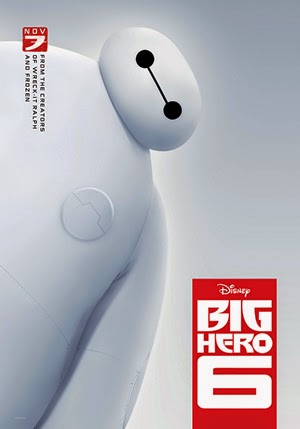
Big Hero 6
Big Hero 6
Dirs. Don Hall and Chris Williams
3.5 out of 5
Disney's acquisition of Marvel Comics, while a surprise at the time, looks like a shrewder investment every day - not just because of the financial rewards and infusion of adaptation-ready IPs, but also in its tacit recognition that superhero stories are the fairy tales of the modern age. Nowhere is this clearer than in Big Hero 6, a film that combines the whiz-bang of manga-influenced comic book action with the sentimental through-lines of a traditional Disney animated feature.
In the futuristic Pacific Rim metropolis of San Fransokyo, science prodigy Hiro Hamada (Ryan Potter) spends his time constructing "battlebots" and hustling adults in the city's underground robot fight clubs, despite the scolding of his older brother Tadashi (Daniel Henney), a student at the local institute of technology. Concerned that Hiro is wasting his talents, Tadashi introduces him to Baymax (Scott Adsit), a robotic healthcare assistant developed by Tadashi himself. When a mysterious masked individual starts committing acts of techno-terrorism, Hiro and a spunky cohort of other young inventors must transform themselves into a ragtag group of avengers using their own cutting-edge science.
Though the plot turns on a sudden tragedy that pushes Hiro into pursuing cutting-edge research as a coping mechanism, Baymax is clearly the linchpin of the film. Combining the polite, servile attitude of Siri with the huggable body of the Michelin Man, Baymax guides the young protagonist on a journey of emotional self-discovery thinly disguised as a standard superhero vigilante story. Big Hero 6 covers a lot of familiar ground - it borrows heavily from Brad Bird's superior animated classics The Iron Giant and The Incredibles, as well as the "boy and his dog" story archetype - and character development is simplistic bordering on clunky, taking a step back from the more complex relationships of recent Disney films like Frozen. (At one point, Hiro informs his own brother that their mother died when he was a toddler.)
But what in lacks in narrative originality, Big Hero 6 makes up in sheer energy and colorful, kaleidoscopic visuals: the metropolitan mash-up of San Fransokyo is just as whimsical and detailed as any fairytale realm, and much more diverse to boot. It's also heartening to see a film determined to rev kids up about science, with heroes applying their intellect to save the day. In this, the movie is admittedly as nuanced as mixing baking soda and vinegar inside a clay volcano. But passion for a subject feeds off an emotional enthusiasm. You've got to dream it before you can do it, and Big Hero 6 gives a kinetic kick-start to the imaginations of a plugged-in generation.
Sunday, November 23, 2014
The Theory of Everything
Dir. James Marsh
3 out of 5
The lives of British theoretical physicist Stephen Hawking (Eddie Redmayne) and his first wife, Jane Wilde (Felicity Jones), are dramatized in the lovely but inert The Theory of Everything. The film, based on Wilde's memoirs, heavily emphasizes a romantic angle from the get-go and seldom deviates from the prestige movie playbook. Hawking's major career achievements - most notably, his work on the nature of time and the origins of the universe - are juxtaposed against the development of the motor-neuron disease that gradually robs him of his physical faculties.
The Theory of Everything eschews all the admittedly low-hanging but potentially powerful metaphors - a vibrant mind overcoming a weakened body, a man obsessed with time despite his own uncertain future - in favor of the longitudinal study of a late 20th-century marriage. To its credit, the movie tries to say something worthwhile about the unpredictability of love and the long, difficult arc of human relationships. We see more of the wife's side than we typically do in these biopics; as devoted as Jane is, she finds herself up against obstacles and temptations she could never have foreseen as a young woman spellbound by Hawking's confidence and determination.
But no matter how honest Jones and Redmayne are their performances, the movie reveals little about what makes Hawking - whose life was certainly impacted but not defined by this relationship - such a singular figure. Instead, Hawking's brash real-life personality and groundbreaking science are made cutesy and digestible for maximum uplift. In the end, that's Everything's mission: not to educate, but to inspire. In this the film is rather successful, full of swelling strings and plucky humor. But the lightly patronizing tone of the entire endeavor - which seems to suggest that we should be most impressed by Hawking's suffering - doesn't give that fuzzy feeling enough support to last.
Sunday, November 16, 2014
Foxcatcher
Foxcatcher
Dir. Bennett Miller
3.5 out of 5
Olympic wrestling champion Mark Schultz (Channing Tatum) begins Foxcatcher trapped in a life of quiet indignity. He's ekeing out a living as an amateur athlete and, even worse, feels overshadowed by his more successful and charismatic Olympian brother Dave (Mark Ruffalo). So when eccentric billionaire John E. du Pont (Steve Carrell) cold-calls him and invites him to du Pont's suburban Philadelphia mansion, Mark is thrilled by the potential of catching a huge break, even if he's worried that it might just be another dead end. In a similar way, Foxcatcher does a great job of cultivating an atmosphere where it feels like anything can happen, even though the story turns out to be another straightforward, somber treatise on the American Dream.
Foxcatcher strikes me as a movie that is trying very hard to not blow anything out of proportion. There seems to be little attempt to compress the details of the events that inspired E. Max Frye and Dan Futterman's script, from du Pont's initial recruitment of Mark to oversee an elite wrestling club that lives and practices on his estate, to the two men's downward spiral caused by du Pont's erratic behavior, to Dave's late intervention to save what's left of Mark's career. It's a story ripe with themes of obsession, control, entitlement, and power. Yet, over a languid 130 minutes, Foxcatcher has difficulty emphasizing any of that. The garish details are exquisite (the art direction of the du Pont estate is essay-worthy) but the bigger picture remains muddled. Scenes simply come one after the other, make their single point, and then dissolve into memory.
Though a haphazard script and poor pacing threatens to sink Foxcatcher the longer it lasts, excellent performances keep it afloat. Director Bennett Miller is terrific with actors - remember, he guided Philip Seymour Hoffman to an Oscar in Capote and Brad Pitt to one of his most substantive star turns in Moneyball - and he proves this once more through his two leading men. Tatum is better than he's ever been, seemingly tensing every muscle in his body, transmitting both the frustration of a world-class athlete struggling to remain on top and the discomfort of an employee working for a psycho boss. Speaking of discomfort, there is Carrell, taking his gift of awkwardness and sanding off the cartoon safeguards to create something truly unnerving. He also does this while making a physical transformation: his beak-like nose, prosthetic teeth, and affected slouch make him resemble Gru, his animated alter ego in the Despicable Me films, only with way more creepy menace. (There's also fine work, as usual, from Ruffalo and Vanessa Redgrave as du Pont's disapproving mother.)
Foxcatcher presents itself as a tightly-coiled drama about what it takes to succeed in life's many arenas, be they athletic or interpersonal. In reality, it's the cinematic equivalent of an awkward pause. What the movie needs is to be more like Dave: assured, inquisitive, interesting. Instead, it is like Mark, a character burning with competitive fire but fundamentally a blank space, who eventually turns into a sullen child caught in the middle of a custody battle. Ultimately Foxcatcher always says what it means; it just has trouble saying it with meaning.
Subscribe to:
Comments (Atom)